
Dear BTF Community,
What makes a business valuable to the people who might one day buy it?
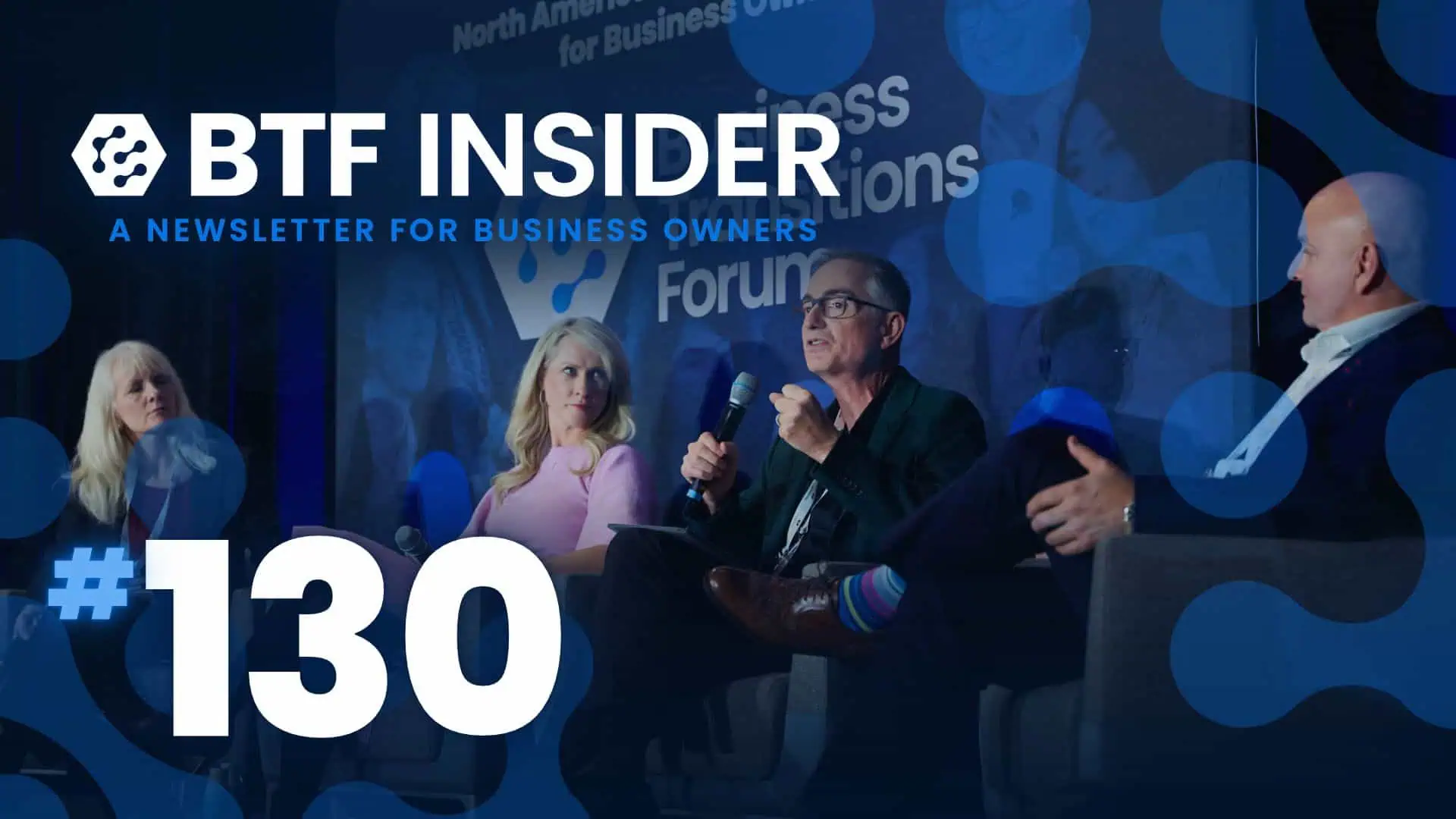
That question took centre stage at BTF Vancouver 2026, closing out a standout year of honest conversations, practical insights and connections across Canada’s business community.
As we look towards an even bigger 2027, here are five lessons from Vancouver that every business owner should carry forward.
Key Takeaways:
- Know your value. Understand what buyers see beyond the numbers.
- Build independent leadership. Make your business less reliant on you.
- Prepare for scrutiny. Address risks before they threaten a deal.
- Define your ideal exit. Price is only part of the equation.
- Create competition. The right buyers can change the outcome.
Enjoy,
Mark

1. Know Where Your Value Really Is
“You need to know where your value is, not just what your value is.”
That observation from Kimberly Burns, Partner at Dentons, during M&A Reality Check captured one of Vancouver’s most important discussions.
Moderated by Matt Price of BDC Capital, the panel brought together Kimberly Burns, Daniel Hinz of Baker Tilly Canada Capital and Ji Yoon of Canstar Group of Companies to examine how buyers are evaluating businesses amid shifting market conditions.
Tariffs, valuation expectations and AI-powered due diligence are changing the transaction landscape. Yet the fundamentals remain: predictable earnings, reliable financial information, strong management and a clear understanding of risk.
Buyers want confidence that today’s performance can be sustained tomorrow.
For owners, that means looking beyond the headline valuation and understanding which parts of the business genuinely drive enterprise value.
The question to consider: Would a prospective buyer see the same strengths and vulnerabilities that you do?
2. Build a Business That Doesn’t Need You
“Our need to be needed is often greater than the team’s need to need us.”
During The Irrelevant Leader, Phil Jewell of Impact Leadership challenged a deeply ingrained instinct among entrepreneurs: the need to remain indispensable.
Drawing on his military experience, Phil recalled being removed from his team for 48 hours during a leadership assessment. His success depended entirely on how effectively his people performed without him.
For business owners, the implications extend well beyond leadership style.
During Attract, Impress, Exit, Duane Hepditch, Founder of Pulse & Openfood.ai, reflected on selling his software business and the difficulties of managing a transaction without a sufficiently independent leadership team.
With his attention consumed by the sale, the business continued to depend on him.
Founder dependency can become a valuation risk. A capable management team, documented processes and clear decision-making authority give buyers greater confidence that a company can succeed under new ownership.
The strongest leaders build businesses that no longer require their involvement in every decision.
3. Fix the Problems Before Buyers Find Them
A deal can lose momentum long before anyone reaches the negotiating table.
During Attract, Impress, Exit, moderated by Tyler Weese of Scotiabank, Axel Christiansen, Duane Hepditch, Matthew Latimer and Stuart McConnachie examined the operational weaknesses that can undermine otherwise attractive businesses.
The examples were revealing: supplier relationships without written contracts, financial inconsistencies, unclear intellectual property ownership and excessive customer concentration.
Each can introduce uncertainty, delay negotiations or prompt buyers to reconsider their offers.
The panel emphasized the value of preparing financial information for scrutiny well before launching a sale process, including considering a quality of earnings assessment.
Similar lessons emerged during Selling a Business 101, where Emily Savage, Jalal Jetha, Pauline Marshall and Karl Sigerist explored the importance of early planning, experienced advisors and understanding deal terms.
The cost of preparation is often far smaller than the cost of discovering a problem during due diligence.
For owners contemplating a transition in the next three to five years, the work should already be underway.
4. The Best Deal Isn’t Always the Biggest Cheque
“Build a company like you could sell it. You can always choose to hold it.”
Mackenzie Regent of Kalos offered that perspective during The Growth Playbook, alongside Ryan Volberg of Guestologie and moderator Tobin Hayward of Roynat Equity Partners.
Their discussion explored a fundamental advantage of building a resilient, well-managed business: having the freedom to decide what comes next.
That freedom matters when evaluating a potential transaction.
During Selling a Business 101, Pauline Marshall of CBIG reflected on her own exit experience, explaining why preserving company culture, employee continuity and autonomy influenced the choice of buyer.
Meanwhile, Stuart McConnachie of Edward Jones highlighted three dimensions of exit readiness: business readiness, personal financial readiness and personal readiness for life after ownership.
A compelling valuation doesn’t automatically translate into a successful transition.
The right deal should support the owner’s financial future, protect the priorities that matter and create a clear path forward for the business.
5. Make Buyers Compete for Your Business
More than $2.5 million in additional value. Just two weeks.
That was the result of competitive tension in a real transaction brought to life during The Deal Tank.
Moderated by Don Montgomery of True North M&A, the session featured Jessica Cullen of Raven & Dynamic Rescue Systems, Jeff Linner of PFM Capital and Jack Dallaire of SeaFort Capital, representing strategic, private equity and search fund buyers.
Working from the same business information, each presented a different approach to valuation, deal structure, employee retention and ownership transition.
The audience weighed the competing offers before discovering how the actual transaction unfolded.
The sale attracted more than 10 competitive offers, with a private equity buyer ultimately securing the deal despite not having submitted the highest initial offer.
Don captured the broader lesson:
“Value doesn’t come from the business alone. It comes from the buyer pool.”
A well-managed process can create meaningful competition, improve negotiating leverage and help owners find a buyer aligned with their priorities.
What a business is worth depends partly on who’s at the table, and how effectively they’re encouraged to compete.
Final Reflection: A Bigger Year, a Growing Community
BTF Vancouver brought our 2026 conference season to a close, marking another year of bringing Canada’s business ownership and transition community together.
From Alberta and Atlantic Canada to Toronto, Saskatoon, Winnipeg and Vancouver, we’ve seen firsthand the value of creating spaces where owners, entrepreneurs, investors and advisors can exchange experiences, challenge assumptions and build meaningful relationships.
The conversations haven’t always been comfortable but that’s exactly what makes them valuable.
Behind every successful transition are decisions about people, growth, ownership and legacy. Hearing directly from those who’ve navigated them helps the next generation of business owners make more informed choices.
In 2027, we’re building on that momentum.
Alongside our returning BTF conferences across Canada, we’re excited to be expanding into Ottawa and Montréal, bringing these conversations to two more business communities.
It’s an opportunity to connect more Canadian owners with the expertise, perspectives and relationships that can help shape their next chapter.
As our community grows, our focus remains the same: helping business owners build stronger companies, create more options and make better decisions about their future.
Thank you to everyone who joined us, shared their experiences and contributed to BTF throughout 2026.
Here’s to new conversations, new connections and an even stronger 2027.